
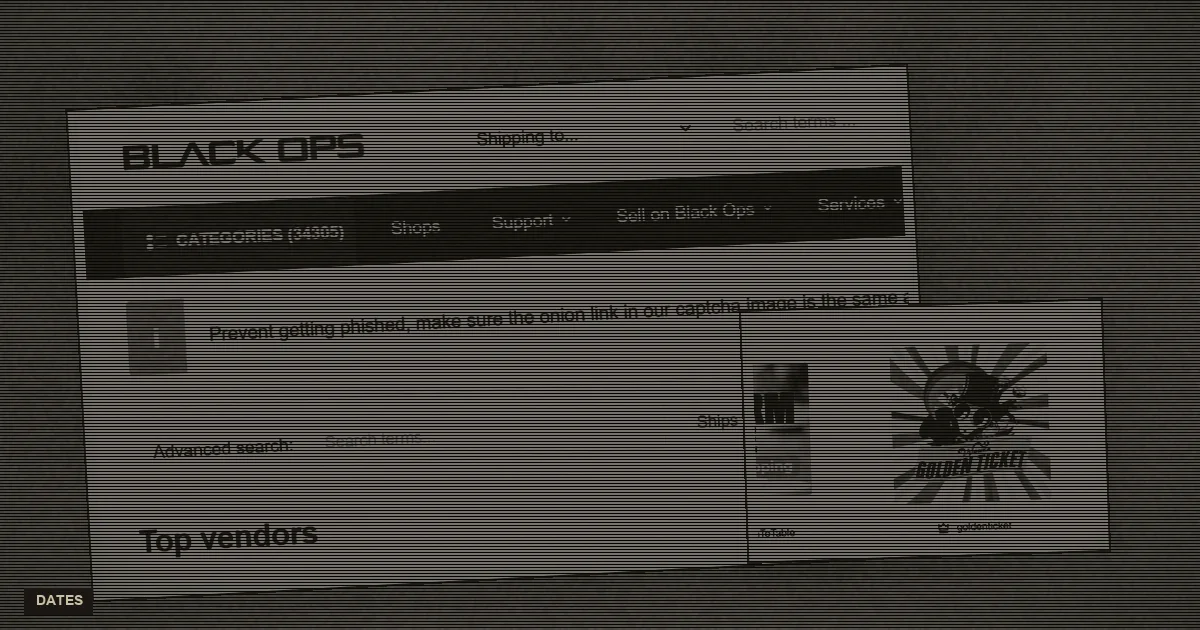
blackops onion
Every chronology of a hidden service is partly a history of public chatter. The dates below were compiled from open blogs, tracker databases, and journalism for readers who searched blackops onion and expected a founding document. No founding document exists. Hidden services do not register with a public authority. Where the evidence is thin, this table stays empty rather than inventing a date.
A timeline has one genuine use in this context: phishing domains are often younger than the brand they impersonate. Knowing that a brand entered discussion in a particular year tells you that a domain registered last month is probably not what it claims. It does not tell you that any specific address belongs to any specific operator.
When a signed operator post with a verifiable date appears, it belongs here. Unsigned forum screenshots and Telegram archives do not, because they cannot be traced to a key. For the methodology behind these choices, see the dossier chapter on how open timelines fail.
How blackops tor blogs mint launch windows
Secondary blackops tor write-ups cluster a launch window somewhere in the second half of 2024. That clustering reflects journalists and bloggers citing each other, not a corroborated registry event. Hidden services do not publish articles of incorporation, and no dated primary source pins a specific key to a specific day. Treat the window as a reasonable estimate, not a fact.
By 2025, clearnet wiki farms around the name became routinely observable in search results. That growth curve tells us something about SEO economics, not about operational uptime. A dozen sites repeating the same three sentences do not corroborate a launch date; they corroborate each other's willingness to repeat it.
Going into 2026, tracker language still tags the brand as discussed-active. Tracker datasets are characteristically slow: they lag exits, revivals, and domain rotations by days or weeks. An active tag in a spreadsheet updated on Fridays is not a live status check.
Why blackops darknet listicles over-precision dates
| Window | What public sources report | Confidence level |
|---|---|---|
| 2024 H2 | Brand begins appearing in market round-ups and tracker databases | Medium — secondary sources only |
| 2025 | Clearnet wiki farms around the name become observable in search | High — directly observable in results |
| 2026 | Trackers still tag the brand as discussed-active | Medium — characteristic tracker lag applies |
The blackops darknet listicle genre prizes exact days. Exact days sell screenshots and screenshots sell clicks. This desk refuses to publish a day it did not find in a dated primary. When two intelligence posts disagree about a date, the disagreement itself is the record — not a synthesis that papers over the gap.
Domain age on a clearnet host is not the age of a hidden service. A privacy registrar and a free TLS certificate are standard practice; they are not a birth certificate. Readers who want a richer table should ask what evidence fills the extra rows. Padding a chronology is a reliable tell of clone content.
If a signed operator text with a date appears after this publication date, it should enter a later revision. Unsigned Telegram dumps and forum screenshots should not.
When should a new date enter this table?
Readers who arrived on the blackops onion query often use age as a proxy for trustworthiness. That logic is understandable but backward in this context. Strings rotate after seizures, infrastructure panics, and routine operator decisions. The age of a brand in discussion is not the age of any particular address, and an address that has been in circulation for eighteen months is not therefore safer than one issued last week.
For the method behind these choices, see the open-timeline dossier chapter. For the citation policy, see sources. Neither of those pages treats a tracker table as a court record.
If a signed message with a date appears after 1 September 2026, it should enter a later revision of this sheet. An unsigned Telegram dump should not.
Sparse chronology is a method, not a mood. Writers who paste a founding month into a table are usually pasting someone else's sentence. This desk records the copy-chain instead of laundering it into a confident day.
Phishing domains are often younger than the brand they impersonate, which is why age of a .com shows up in smell tests. Youth is still not a verdict. Operators burn domains. Clones buy them. Both facts can be true in the same week.
A signed status post with a date is a different artefact from a forum JPEG. The JPEG can be real, fake, or both at once depending on who cropped it. This sheet will not promote a JPEG into a row without a genre tag.
If you use dates as a trust proxy for a paste, you are using the wrong instrument. Age of chatter is not age of a particular hidden-service name. Names rotate after panic, boredom, and seizures. The table cannot freeze them honestly.
Read the method chapter if you want the argument at length. Stay here if you only needed the three windows and the refusal to invent a fourth. Empty cells are a feature of this record.
Timeline questions that keep coming back
Why is this chronology so short?
Because most of the dates circulating in the ecosystem were copied from early write-ups that themselves lacked primaries. A short table with honest confidence labels is more useful than a long one that looks authoritative but cannot show its work. Secondary listicles that stamp exact days are decoration, not documentation.
Does a young clearnet domain prove the site is a clone?
No, though it raises the prior probability. Operators burn and rotate clearnet domains for legitimate operational reasons. Youth combined with conversion-heavy copy, a rotating onion address, and an absent signature is a stronger signal. Any single indicator is insufficient.
Should seizure headlines appear in this table?
Only when a dated primary — an agency announcement, a court document, a verifiable screenshot — exists and can be described neutrally. Fake seizure pages targeting the same search traffic exist and are designed to be convincing. A blackops market headline in a forum post is not a primary source.
Use dates to slow down, not to certify. A long chronology that cannot cite its sources is a style choice, not a historical record. This desk would rather look incomplete than authoritative about things it has not confirmed.
If you came here to date-stamp an address, this table cannot help. The blackops onion string you found in a search snippet has no birthday this desk can honestly assign. Read the mirrors sheet and the clone-surface chapter next.